ChatGPT is becoming a search engine. Here is exactly how DFW business owners can make sure their business shows up when customers ask ChatGPT for local recommendations.


ChatGPT is becoming a search engine. Here is exactly how DFW business owners can make sure their business shows up when customers ask ChatGPT for local recommendations.

Local SEO and AI search use the same signals. Learn how optimizing your Google Business Profile, citations, and reviews helps DFW businesses get found in ChatGPT and Google AI.

Find your Business Profile primary owner and access roles before changing marketing agencies.

Check administrator roles, manager links, billing, and tracking before changing agencies.
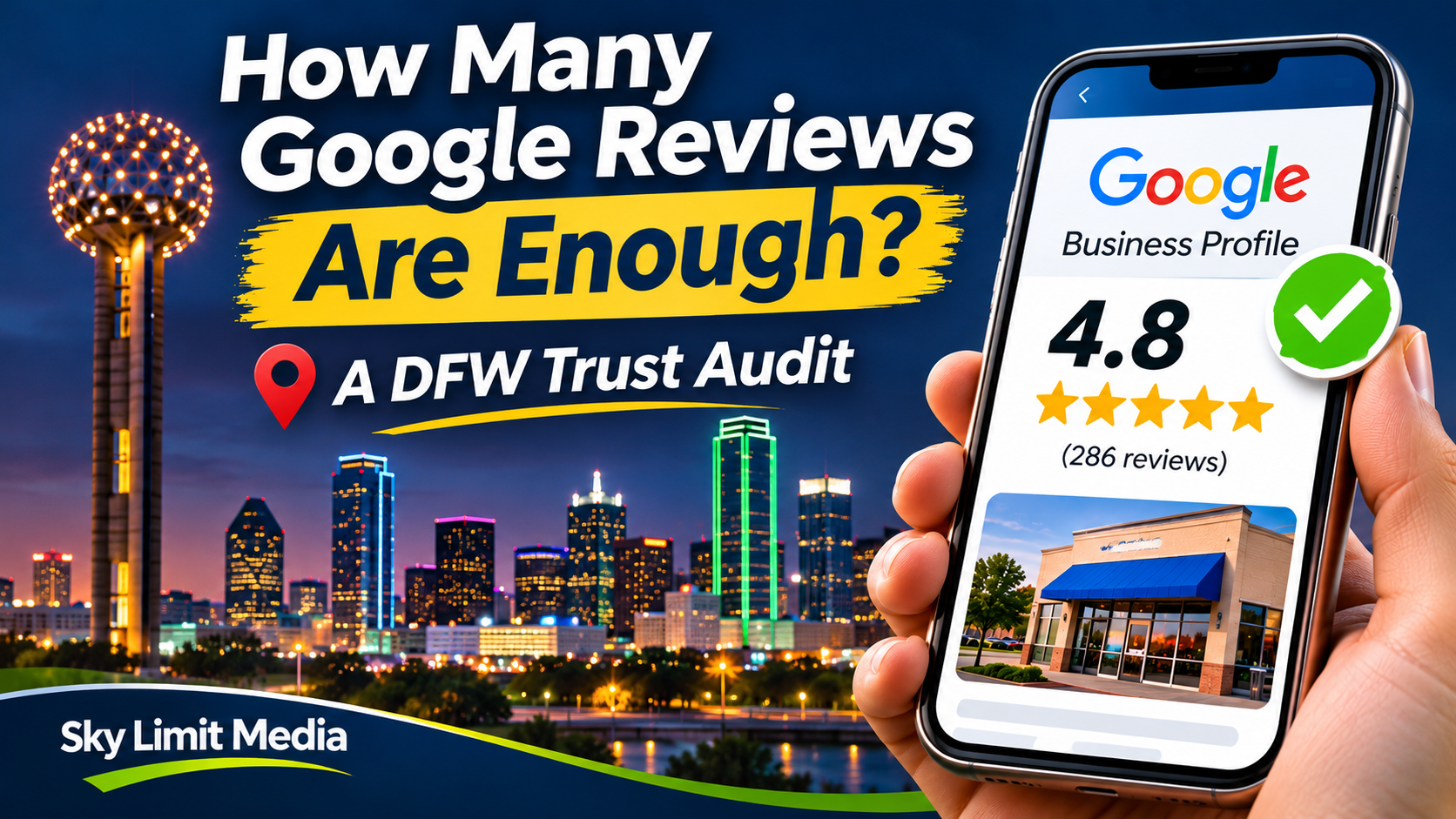
Quick answer: There is no universal number of Google reviews that every local business needs. A credible target depends on your service category, location, direct competitors, review recency, and how consistently your business earns genuine feedback. For a Dallas–Fort Worth business, the useful question is not “What magic number guarantees rankings?” It is “What review profile will help a customer confidently choose us over the realistic alternatives nearby?”
If you are wondering how many Google reviews a local business needs, this guide gives you a practical way to set a defensible target without guessing, buying reviews, or chasing an arbitrary milestone.
A plumber in Plano, a dentist in Frisco, and a remodeling contractor in McKinney do not compete in the same review environment. Even businesses in the same city may face different expectations because customers evaluate risk differently. Choosing a restaurant for lunch is not the same decision as selecting a roofer, medical practice, attorney, or financial professional.
Google does not publish a review-count threshold that unlocks a particular local ranking. Its local ranking guidance explains that results are mainly based on relevance, distance, and prominence. Google also says that more reviews and positive ratings can help local ranking, but that is not a promise that a specific count will produce a specific position. You can read Google’s official explanation of how local ranking works.
Review count matters, but it is only one signal customers can see. They also notice the average rating, the dates of recent reviews, whether comments describe real services, how the business responds, and whether negative feedback is handled professionally. A high total with no recent activity can look less reassuring than a smaller profile that shows steady, authentic customer experiences.
The safest goal is competitive credibility: a review profile strong enough to reduce doubt for the customers you actually want, while remaining genuine and policy-compliant. Your target should come from a local benchmark, not a national average or an unsupported “ideal” number.
This approach also prevents a common mistake: treating reviews as a standalone shortcut. Reviews work best when your Google Business Profile is accurate, your services are clearly described, and your website supports the same local promise. If those foundations need attention, start with our Google Business Profile optimization service and local SEO service.
You do not need paid software to complete this first-pass audit. Use an incognito or signed-out browser, search from the market you serve, and document what you can verify. Results can vary by location and user context, so treat the exercise as a directional customer-view audit—not a scientific ranking study.
Choose one high-intent search that describes the service and location, such as “emergency plumber Plano,” “family dentist Frisco,” or “kitchen remodeling McKinney.” Avoid a broad search such as “best business.” The closer the query is to a real buying decision, the more useful the comparison becomes.
Write down the search, the city, and the date. If you serve several DFW communities, repeat the audit for your priority locations rather than assuming one city represents the entire market. Our Dallas–Fort Worth service-area hub shows how local markets can be organized without treating every city as identical.
Review the businesses that appear prominently for the query. Record the business name, visible review count, average rating, date of the newest review, and whether the profile appears to match the service searched. Exclude directories, businesses outside the realistic service area, and companies that do not provide the same core service.
Do not copy the highest number and call it your target. A large multi-location brand may have advantages that do not apply to an independent local company. Focus on direct competitors a customer could realistically choose instead of you.
Look beyond the lifetime total. Check whether reviews appear steadily across recent months or arrive in unusual bursts. A healthy system normally reflects an ongoing flow of completed customer experiences. Your target should therefore include both a count milestone and a repeatable pace that your team can maintain ethically.
For example, “earn ten genuine reviews as quickly as possible” is weaker than “ask every eligible customer through the same documented process and review progress monthly.” The second goal improves the system rather than encouraging pressure, selective requests, or shortcuts.
Specific reviews often carry more trust than vague praise. Look for natural mentions of the service performed, the problem solved, communication, timeliness, location, and outcome. Do not script those details for customers. Instead, make the request easy and let each customer describe the experience in their own words.
This qualitative review also reveals operational gaps. If competitors are repeatedly praised for responsiveness and your reviews rarely mention communication, the answer may be a better follow-up process—not simply a larger review total.
Check whether competitors respond to positive and negative reviews. A useful response acknowledges the customer, refers to the experience without exposing private information, and invites offline resolution when needed. Repetitive responses copied word for word can feel automated and may miss the concern behind the review.
Google says thoughtful replies show customers that a business values their feedback. Responses also give future customers evidence of how your team communicates when an experience goes well—or when something needs to be corrected.
Set a near-term credibility milestone and a longer-term competitive milestone. The near-term milestone should close the most obvious trust gap, such as an outdated profile or a long period without feedback. The longer-term milestone should move your review profile toward the credible range visible among direct local competitors.
Keep the milestones realistic. A business with twelve reviews should not build its process around reaching five hundred immediately. It should first create a reliable request-and-response workflow, then measure whether review recency, profile engagement, calls, and qualified leads improve over time.
The best review program is simple, consistent, and tied to a genuine customer experience. Ask eligible customers at a natural point after service, provide the direct review link, and give them space to write honest feedback. Apply the process consistently instead of asking only customers you expect to leave a positive rating.
Google prohibits offering incentives in exchange for reviews. The Federal Trade Commission also prohibits fake reviews and addresses incentives, disclosures, and review suppression in its Consumer Reviews and Testimonials Rule guidance. A short-term spike is never worth a policy violation or a loss of customer trust.
Keep the message neutral and human:
Thank you for choosing [Business Name]. If you have a moment, we would appreciate your honest feedback about your experience. Your review helps our team improve and helps local customers make an informed decision: [Google review link]
This message asks for honest feedback, not a five-star review. Before using it, confirm that the customer is eligible, the link reaches the correct verified business profile, and your industry does not impose additional privacy or solicitation rules.
For positive reviews, thank the customer and refer briefly to the service when appropriate. Avoid stuffing the response with cities and keywords. The reply is primarily customer communication, not a place to manufacture search phrases.
For a negative review, pause before responding. Acknowledge the concern without arguing, protect confidential information, and move the detailed conversation offline. If the review appears to violate platform policy, document the issue and use the available reporting route. Do not threaten, expose, or pressure the reviewer.
A practical response framework is: acknowledge, clarify what can be stated publicly, offer a reasonable next step, and provide a direct contact path. Then review the underlying issue internally. The strongest reputation system does not merely collect praise; it helps the business identify and fix recurring service problems.
A stronger review profile may improve trust and can support local visibility, but customers still need a clear path from discovery to action. Your profile should have accurate hours, services, contact details, photos, and a working website link. Your website should load well on mobile, explain the offer, and make calling or requesting a consultation easy.
If people reach your website but do not contact you, review our 30-minute lead audit for local businesses. It helps separate a reputation problem from a website message, usability, or contact-path problem.
There is no universal cutoff. Benchmark direct competitors for the same service and location, then build a steady flow of genuine, recent reviews. The goal is credible customer evidence, not an arbitrary number.
Google says review count and positive ratings can help local ranking, but local results also depend on relevance, distance, and prominence. No review count guarantees a specific position.
They may be enough to establish initial credibility in one market and insufficient in another. Compare the number, recency, rating, and substance of reviews among true local competitors before setting the next milestone.
Build the request into a consistent post-service workflow for eligible customers. A steady process is more sustainable and credible than occasional campaigns that create abrupt bursts.
No. Google prohibits incentives in exchange for reviews. Ask for honest feedback without offering money, discounts, gifts, contest entries, or other benefits.
Responding consistently is a strong practice when your replies are timely, specific, and privacy-conscious. Prioritize meaningful communication over copied responses.
The right review target is not a magic number. It is a measurable step inside a larger local growth system: accurate profile information, genuine customer feedback, professional responses, strong service pages, and an easy contact path.
Sky Limit Media helps Dallas–Fort Worth businesses audit their Google Business Profile, local competitors, website journey, and review-request process. Request a consultation to identify the trust gap most likely to cost you qualified leads—and the safest next step to close it.