

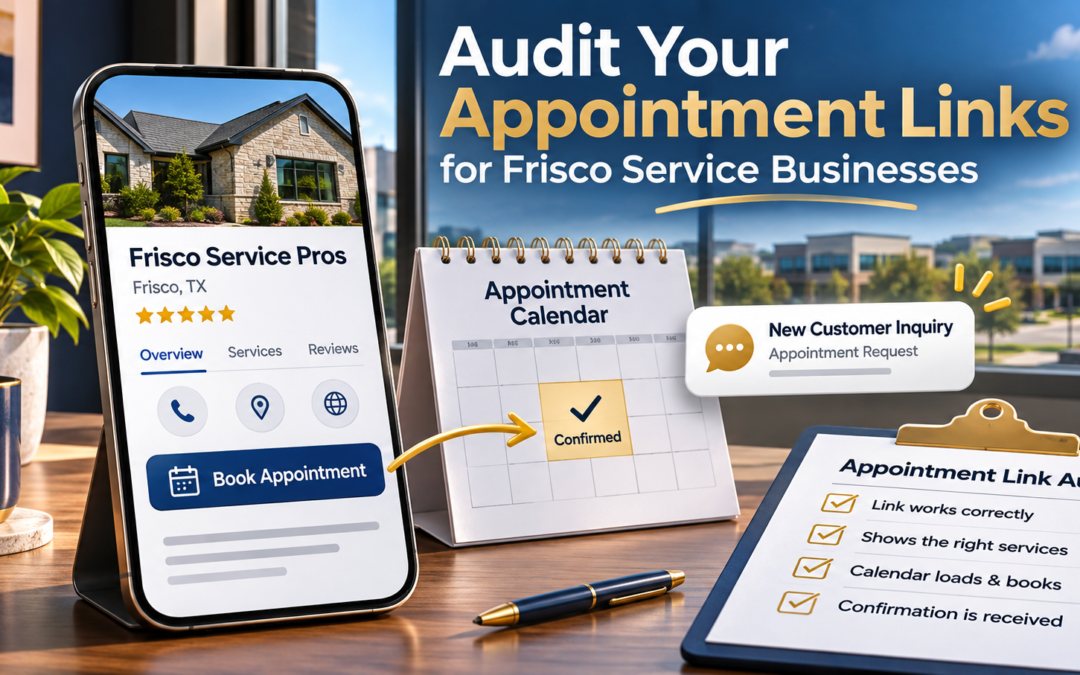
Google Business Profile Appointment Links: A Lead Audit for Frisco Service Businesses
Frisco service businesses: use this 25-minute audit to check Google Business Profile appointment links, mobile booking paths, notifications, and confirmed leads.

Slow Mobile Website, Lost Local Leads? A 20-Minute Speed Audit for Richardson Businesses
A 20-minute mobile website speed and lead audit for Richardson businesses: Core Web Vitals, contact paths, and practical fixes.
Google Ads Clicks but No Booked Estimates? An Allen Contractor Lead Audit
Allen contractors: learn why Google Ads clicks do not become booked estimates, and use a practical 30-minute audit of targeting, landing pages, calls, and lead follow-up.
How Many Google Reviews Does a Local Business Need? A DFW Trust Audit
Quick answer: There is no universal number of Google reviews that every local business needs. A credible target depends on your service category, location, direct competitors, review recency, and how consistently your business earns genuine feedback. For a Dallas–Fort Worth business, the useful question is not “What magic number guarantees rankings?” It is “What review profile will help a customer confidently choose us over the realistic alternatives nearby?”
If you are wondering how many Google reviews a local business needs, this guide gives you a practical way to set a defensible target without guessing, buying reviews, or chasing an arbitrary milestone.
Why There Is No Single “Right” Review Count
A plumber in Plano, a dentist in Frisco, and a remodeling contractor in McKinney do not compete in the same review environment. Even businesses in the same city may face different expectations because customers evaluate risk differently. Choosing a restaurant for lunch is not the same decision as selecting a roofer, medical practice, attorney, or financial professional.
Google does not publish a review-count threshold that unlocks a particular local ranking. Its local ranking guidance explains that results are mainly based on relevance, distance, and prominence. Google also says that more reviews and positive ratings can help local ranking, but that is not a promise that a specific count will produce a specific position. You can read Google’s official explanation of how local ranking works.
Review count matters, but it is only one signal customers can see. They also notice the average rating, the dates of recent reviews, whether comments describe real services, how the business responds, and whether negative feedback is handled professionally. A high total with no recent activity can look less reassuring than a smaller profile that shows steady, authentic customer experiences.
A Better Target: Competitive Credibility
The safest goal is competitive credibility: a review profile strong enough to reduce doubt for the customers you actually want, while remaining genuine and policy-compliant. Your target should come from a local benchmark, not a national average or an unsupported “ideal” number.
This approach also prevents a common mistake: treating reviews as a standalone shortcut. Reviews work best when your Google Business Profile is accurate, your services are clearly described, and your website supports the same local promise. If those foundations need attention, start with our Google Business Profile optimization service and local SEO service.
The 20-Minute DFW Google Review Trust Audit
You do not need paid software to complete this first-pass audit. Use an incognito or signed-out browser, search from the market you serve, and document what you can verify. Results can vary by location and user context, so treat the exercise as a directional customer-view audit—not a scientific ranking study.
1. Define the Exact Customer Search
Choose one high-intent search that describes the service and location, such as “emergency plumber Plano,” “family dentist Frisco,” or “kitchen remodeling McKinney.” Avoid a broad search such as “best business.” The closer the query is to a real buying decision, the more useful the comparison becomes.
Write down the search, the city, and the date. If you serve several DFW communities, repeat the audit for your priority locations rather than assuming one city represents the entire market. Our Dallas–Fort Worth service-area hub shows how local markets can be organized without treating every city as identical.
2. Record the Visible Competitor Set
Review the businesses that appear prominently for the query. Record the business name, visible review count, average rating, date of the newest review, and whether the profile appears to match the service searched. Exclude directories, businesses outside the realistic service area, and companies that do not provide the same core service.
Do not copy the highest number and call it your target. A large multi-location brand may have advantages that do not apply to an independent local company. Focus on direct competitors a customer could realistically choose instead of you.
3. Compare Recency and Consistency
Look beyond the lifetime total. Check whether reviews appear steadily across recent months or arrive in unusual bursts. A healthy system normally reflects an ongoing flow of completed customer experiences. Your target should therefore include both a count milestone and a repeatable pace that your team can maintain ethically.
For example, “earn ten genuine reviews as quickly as possible” is weaker than “ask every eligible customer through the same documented process and review progress monthly.” The second goal improves the system rather than encouraging pressure, selective requests, or shortcuts.
4. Read What Customers Actually Say
Specific reviews often carry more trust than vague praise. Look for natural mentions of the service performed, the problem solved, communication, timeliness, location, and outcome. Do not script those details for customers. Instead, make the request easy and let each customer describe the experience in their own words.
This qualitative review also reveals operational gaps. If competitors are repeatedly praised for responsiveness and your reviews rarely mention communication, the answer may be a better follow-up process—not simply a larger review total.
5. Evaluate Business Responses
Check whether competitors respond to positive and negative reviews. A useful response acknowledges the customer, refers to the experience without exposing private information, and invites offline resolution when needed. Repetitive responses copied word for word can feel automated and may miss the concern behind the review.
Google says thoughtful replies show customers that a business values their feedback. Responses also give future customers evidence of how your team communicates when an experience goes well—or when something needs to be corrected.
6. Set Two Review Milestones
Set a near-term credibility milestone and a longer-term competitive milestone. The near-term milestone should close the most obvious trust gap, such as an outdated profile or a long period without feedback. The longer-term milestone should move your review profile toward the credible range visible among direct local competitors.
Keep the milestones realistic. A business with twelve reviews should not build its process around reaching five hundred immediately. It should first create a reliable request-and-response workflow, then measure whether review recency, profile engagement, calls, and qualified leads improve over time.
How to Ask for Google Reviews Without Creating Risk
The best review program is simple, consistent, and tied to a genuine customer experience. Ask eligible customers at a natural point after service, provide the direct review link, and give them space to write honest feedback. Apply the process consistently instead of asking only customers you expect to leave a positive rating.
- Ask after the customer has received the service or product.
- Use the same approved request process across eligible customers.
- Make the review link easy to reach by email, text, receipt, or QR code.
- Do not request a specific star rating or provide review wording.
- Do not use employees, fake accounts, or purchased review services.
- Do not hide the review option from customers who report a poor experience.
Google prohibits offering incentives in exchange for reviews. The Federal Trade Commission also prohibits fake reviews and addresses incentives, disclosures, and review suppression in its Consumer Reviews and Testimonials Rule guidance. A short-term spike is never worth a policy violation or a loss of customer trust.
A Simple Review Request Message
Keep the message neutral and human:
Thank you for choosing [Business Name]. If you have a moment, we would appreciate your honest feedback about your experience. Your review helps our team improve and helps local customers make an informed decision: [Google review link]
This message asks for honest feedback, not a five-star review. Before using it, confirm that the customer is eligible, the link reaches the correct verified business profile, and your industry does not impose additional privacy or solicitation rules.
How to Respond to Reviews Professionally
For positive reviews, thank the customer and refer briefly to the service when appropriate. Avoid stuffing the response with cities and keywords. The reply is primarily customer communication, not a place to manufacture search phrases.
For a negative review, pause before responding. Acknowledge the concern without arguing, protect confidential information, and move the detailed conversation offline. If the review appears to violate platform policy, document the issue and use the available reporting route. Do not threaten, expose, or pressure the reviewer.
A practical response framework is: acknowledge, clarify what can be stated publicly, offer a reasonable next step, and provide a direct contact path. Then review the underlying issue internally. The strongest reputation system does not merely collect praise; it helps the business identify and fix recurring service problems.
Reviews Support Local SEO, but They Do Not Replace Conversion Work
A stronger review profile may improve trust and can support local visibility, but customers still need a clear path from discovery to action. Your profile should have accurate hours, services, contact details, photos, and a working website link. Your website should load well on mobile, explain the offer, and make calling or requesting a consultation easy.
If people reach your website but do not contact you, review our 30-minute lead audit for local businesses. It helps separate a reputation problem from a website message, usability, or contact-path problem.
Frequently Asked Questions
How many Google reviews does a local business need?
There is no universal cutoff. Benchmark direct competitors for the same service and location, then build a steady flow of genuine, recent reviews. The goal is credible customer evidence, not an arbitrary number.
Do more Google reviews improve local ranking?
Google says review count and positive ratings can help local ranking, but local results also depend on relevance, distance, and prominence. No review count guarantees a specific position.
Are twenty Google reviews enough?
They may be enough to establish initial credibility in one market and insufficient in another. Compare the number, recency, rating, and substance of reviews among true local competitors before setting the next milestone.
How often should a business ask for reviews?
Build the request into a consistent post-service workflow for eligible customers. A steady process is more sustainable and credible than occasional campaigns that create abrupt bursts.
Can I offer a discount for a Google review?
No. Google prohibits incentives in exchange for reviews. Ask for honest feedback without offering money, discounts, gifts, contest entries, or other benefits.
Should I respond to every Google review?
Responding consistently is a strong practice when your replies are timely, specific, and privacy-conscious. Prioritize meaningful communication over copied responses.
Turn Your Review Count Into a Trust System
The right review target is not a magic number. It is a measurable step inside a larger local growth system: accurate profile information, genuine customer feedback, professional responses, strong service pages, and an easy contact path.
Sky Limit Media helps Dallas–Fort Worth businesses audit their Google Business Profile, local competitors, website journey, and review-request process. Request a consultation to identify the trust gap most likely to cost you qualified leads—and the safest next step to close it.