ChatGPT is becoming a search engine. Here is exactly how DFW business owners can make sure their business shows up when customers ask ChatGPT for local recommendations.


ChatGPT is becoming a search engine. Here is exactly how DFW business owners can make sure their business shows up when customers ask ChatGPT for local recommendations.

Local SEO and AI search use the same signals. Learn how optimizing your Google Business Profile, citations, and reviews helps DFW businesses get found in ChatGPT and Google AI.

A practical agency handover plan for DFW businesses: secure your domain, website, Business Profile, ad accounts, analytics, and tracking numbers before switching.

Learn how to check who controls your business domain, registrar account, renewal, and DNS before changing agencies.
Quick answer: A Plano small business should choose SEO or PPC by using its own sales timeline, gross profit, close rate, website readiness, and tracking—not a generic pros-and-cons list. Choose PPC first when you need faster market feedback and can track qualified leads. Choose SEO first when customers repeatedly search for your services and you can invest in useful pages and long-term visibility. Use both only when the budget can support two properly measured channels.
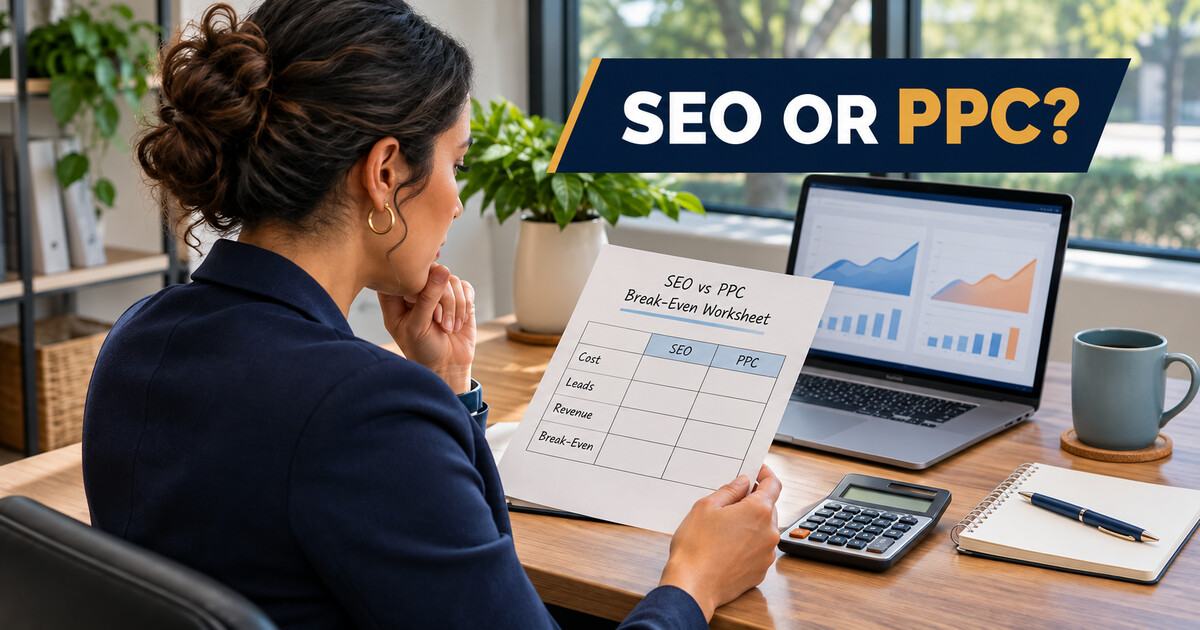
This SEO vs. PPC for Plano small businesses worksheet helps you calculate a break-even boundary before spending money. It does not use borrowed click costs, conversion rates, or lead values. Your accounting records, CRM, call logs, and completed jobs are the right inputs.
SEO improves how well search engines can crawl, understand, and present your website in organic results. It includes work such as technical fixes, service pages, internal links, useful content, local information, and measurement. You do not pay Google for each organic click, but SEO still requires time, expertise, content, and implementation.
PPC uses paid ads to compete for visibility in search results. Google Ads can start collecting traffic sooner than SEO, but each click can cost money and no click is guaranteed to become a qualified lead. PPC also needs a clear offer, focused landing page, conversion tracking, negative keywords, budget control, and sales follow-up.
Google’s official SEO vs. PPC guide explains that PPC can support shorter-term traffic goals while SEO can strengthen longer-term online visibility. It also confirms that paying for Google Ads does not improve organic rankings.
Review Sky Limit Media’s SEO services and Google Ads management before comparing proposals. The scope matters as much as the monthly price.
Gross profit per new customer = collected revenue − direct cost to deliver the work.
Use collected revenue, not the largest possible invoice. Subtract direct labor, materials, fulfillment, and subcontractor costs. If customer values vary widely, use a conservative range rather than one optimistic average.
Break-even lead value = gross profit per new customer × qualified-lead close rate.
Example: if gross profit is $1,000 and 20% of qualified leads become customers, the mathematical break-even value is $200 per qualified lead before overhead and risk. That is a ceiling, not a recommended target. Your operating target should leave room for management cost, sales time, missed calls, refunds, unqualified contacts, and profit.
Break-even cost per click = break-even lead value × click-to-qualified-lead rate.
If a qualified lead is worth $200 at break-even and 5% of paid clicks become qualified leads, the mathematical ceiling is $10 per click before management and other campaign costs. Do not use this example as a Plano benchmark. Replace every number with verified campaign and business data.
Lead quality matters. Google recommends assigning conversion values that reflect business value, such as revenue, profit, or lead scores. Its value-based bidding guidance also stresses accurate tracking and meaningful differences between conversion values.
SEO cost per incremental qualified lead = total SEO investment during the measurement window ÷ additional qualified organic leads.
Total SEO investment should include agency or staff time, content, development, software, and approved implementation. Compare qualified leads against a documented baseline. Account for seasonality, brand searches, tracking gaps, and major website changes. More traffic without better-fit enquiries is not automatically a business win.
Break-even math can still recommend the wrong channel when operations are not ready. Before increasing traffic, confirm that someone can answer calls, the team can handle more work, the website explains the offer on mobile, forms reach the right inbox, and leads can be separated from spam, vendors, and job applicants.
If the website or contact path is the constraint, fix it first. The Plano digital marketing page explains how SEO, web design, and Google Ads can fit different starting conditions.
Enter conservative numbers from your accounting records, CRM, call logs, and completed jobs. Do not use the example values as Plano market benchmarks.
Assume a Plano service business earns $1,000 in gross profit per new customer and closes 20% of qualified leads. Its mathematical break-even value is $200 per qualified lead before overhead, risk, and required profit. If 5% of paid clicks become qualified leads, the PPC click ceiling is $10. If a six-month SEO investment totals $6,000 and produces 30 incremental qualified organic leads above a documented baseline, the SEO cost is also $200 per qualified lead. Both results only reach mathematical break-even, so the operating target must be lower.
| Your result | Best next step |
|---|---|
| Tracking, landing page, or follow-up is unreliable | Fix the conversion path before scaling SEO or PPC |
| You need fast feedback and verified PPC costs fit below your operating ceiling | Run a controlled PPC test |
| Customers repeatedly search for the service and you can fund useful site improvements over time | Prioritize SEO |
| Both channels fit the budget and can be measured without double-counting customers | Use a coordinated SEO and PPC plan |
| Starting condition | Recommended direction |
|---|---|
| The offer, mobile page, tracking, or lead follow-up is weak | Fix the conversion system first |
| You have a specific high-intent offer, reliable tracking, enough margin, and need faster feedback | Start with a controlled PPC test |
| Customers repeatedly search for the service and the site needs stronger service pages, internal links, or local information | Prioritize SEO |
| The budget can support paid testing and long-term organic improvements with shared measurement | Use a coordinated plan without double-counting customers |
For a Plano service-area business, define whether the campaign should cover Plano only or nearby cities before comparing results. A contractor with urgent, high-value demand may use paid search to test a tightly defined service and area. A professional service with recurring research-driven demand may benefit more from strong service pages and local organic visibility. The decision still depends on verified margin, tracking, competition, and operational capacity—not the city name alone.
Use the current DFW local SEO cost guide to compare scope, implementation, tracking, reporting, and account ownership before signing an agreement.
Paid search can reveal search terms and landing-page behavior from the campaign. Those observations may inform page improvements, but they do not prove organic ranking potential or long-term demand by themselves.
Choose the decision window before launching. PPC needs enough qualified conversion data, not an arbitrary click count. SEO needs time for implementation, crawling, indexing, and customer response. There is no universal duration that guarantees a valid result.
Measure qualified leads, booked appointments or estimates, new customers, collected revenue, gross profit, cost per customer, lead response time, and missed calls. Use rankings, impressions, clicks, and traffic as diagnostic measures—not final business outcomes.
The best channel is the one your business can measure, afford, and operate well. Complete the worksheet with conservative inputs, identify the largest unknown, and run the smallest responsible test that can reduce that uncertainty.
Sky Limit Media can review your gross profit, close rate, lead definition, website readiness, current traffic sources, and budget boundary. Request an SEO vs. PPC break-even review to choose the next step without paying for traffic or content your business is not ready to convert.